
Web development
Manufacturer site, catalogue & 3D configurator — Oasis Aluminium
A full rebuild of the website of an Algerian manufacturer of tunnel boxes and roller-shutter kits: an 85-reference technical catalogue, animated exploded views, a 3D configurator that works out the right kit for each opening, and a quote request that reaches the sales team as a PDF and an Excel file.
- Client
- Oasis Aluminium
- Year
- 2026
- Category
- Web development
Site industriel B2B | Catalogue technique | Configurateur 3D | FR / EN | SEO & GEO

- pages, in French and English
- 120
- catalogue references
- 85
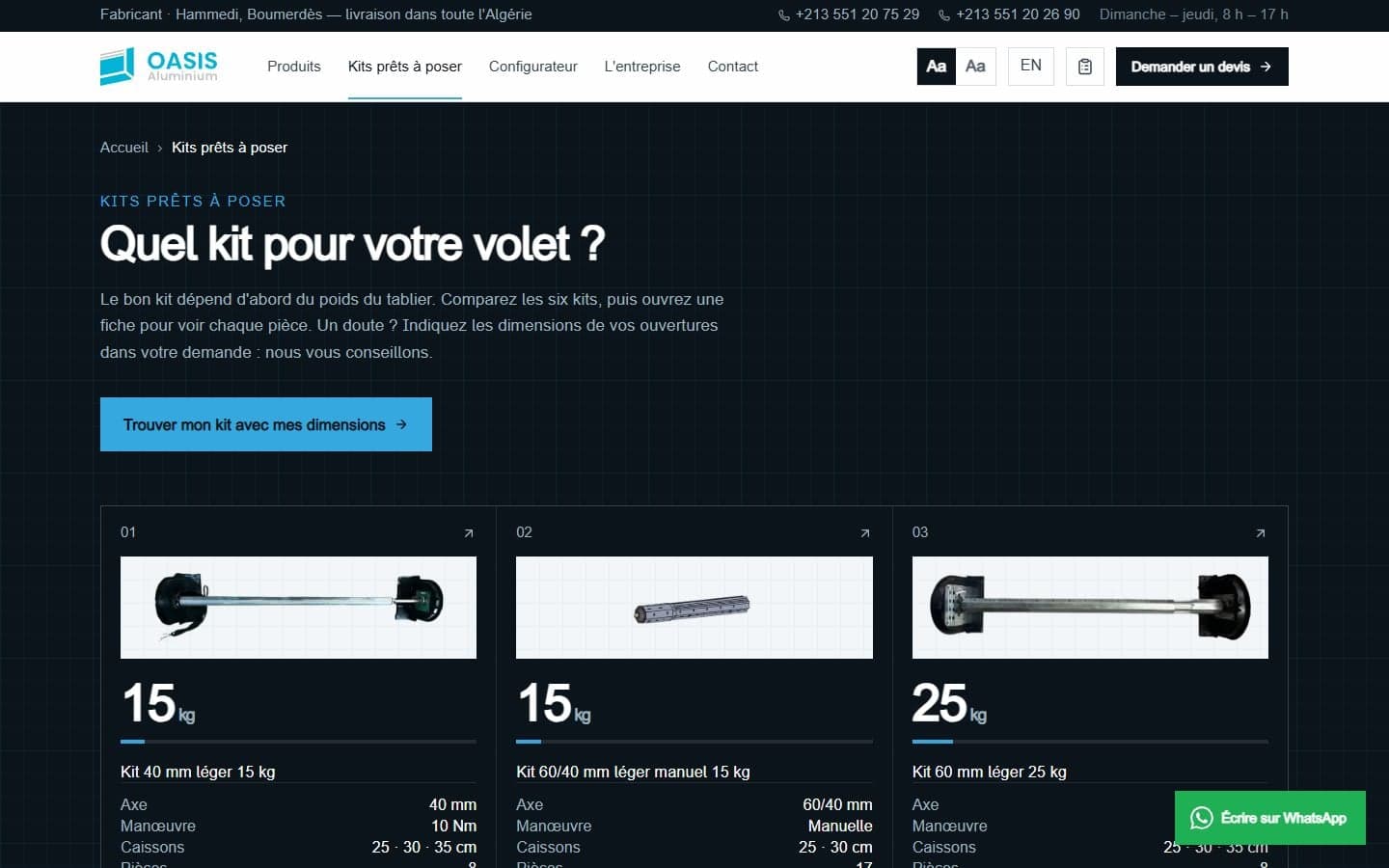
- kits, for 15 to 220 kg curtains
- 6
- points of sale on the map
- 15
Personas
The joiner-installer
Find the right part, its reference and its sizes, then order fast.
He knows the trade and comes with a reference or a size in mind, often from his phone on site. He needs a search that understands “box 35” as well as “K0135”, readable technical sheets, compatibility between parts and a quote that goes out in two steps — not an online checkout the trade doesn't use.
The construction firm
Price dozens of openings on a site in a single request.
It thinks in volumes, lead times and site references. It wants to enter each opening with its sizes, attach its drawings and get an answer from a salesperson rather than a public price — so the site has to pass on a complete, usable request, not a bare contact form.
The renovating homeowner
Understand what they need and where to buy it nearby.
They know neither the references nor the vocabulary (“tandem”, “end cap”, “soffit”). They need to be guided through measuring their opening, to see the result in 3D for reassurance, and a dealer map to finish the purchase close to home.
The business need
Oasis Aluminium manufactures, in Hammedi (Boumerdès), the tunnel boxes, end caps and soffits that build a roller shutter into the masonry, and sells all the motorisation that goes with them. Its WordPress/WooCommerce site didn't show it: a shop full of test products (“caisson tunnel 30 cm (Copy) (Copy)”), pages without a main heading, no image described, references that didn't match between tables and kits, an address too vague for Google Maps, a Gmail address, and nothing on what really sets the company apart — in-house manufacturing, 3D modelling, patents. Above all, a joiner or a homeowner had no way to know which kit fits their opening without phoning.
Diagnosis & research
A full audit of the existing site (HTML, Yoast sitemaps, DNS and mail): titles, H1 tags, alt text, structured data, page weight, indexed test products, URLs to redirect. A page-by-page read of the client's PDF catalogue to rebuild the data — references, sizes, kit contents read from the annotated photos, the tubes' load chart — and a list of open questions wherever the sources disagreed. An online questionnaire, filled in by the client, then settled the positioning, priority audiences, palette and typography.
The approach
A fast, static Next.js site with no back-office and no checkout, French at the root and English under /en. The manufacturer comes first: workshop, know-how, boxes up front. The catalogue groups a product's variants on one page, with search and filters kept in the URL. Every kit gets an animated exploded view and its parts pinned on the photo. The configurator estimates the curtain weight, picks the kit and box, and draws the opening as a dimensioned drawing and in 3D. Products and measured openings go out together in a quote request the sales team receives by email with a summary PDF and an Excel file to price.
Measurable result
A customer can now go from “which opening?” to a complete quote request without phoning: sizes, suggested kit, box and parts reach the salesperson already structured, ready to price in Excel. On the search side, every indexed WordPress URL redirects to its new page, pages are 10 to 20 times lighter, and the site exposes its products, address and FAQ as structured data and in an llms.txt file for AI assistants.
Home page
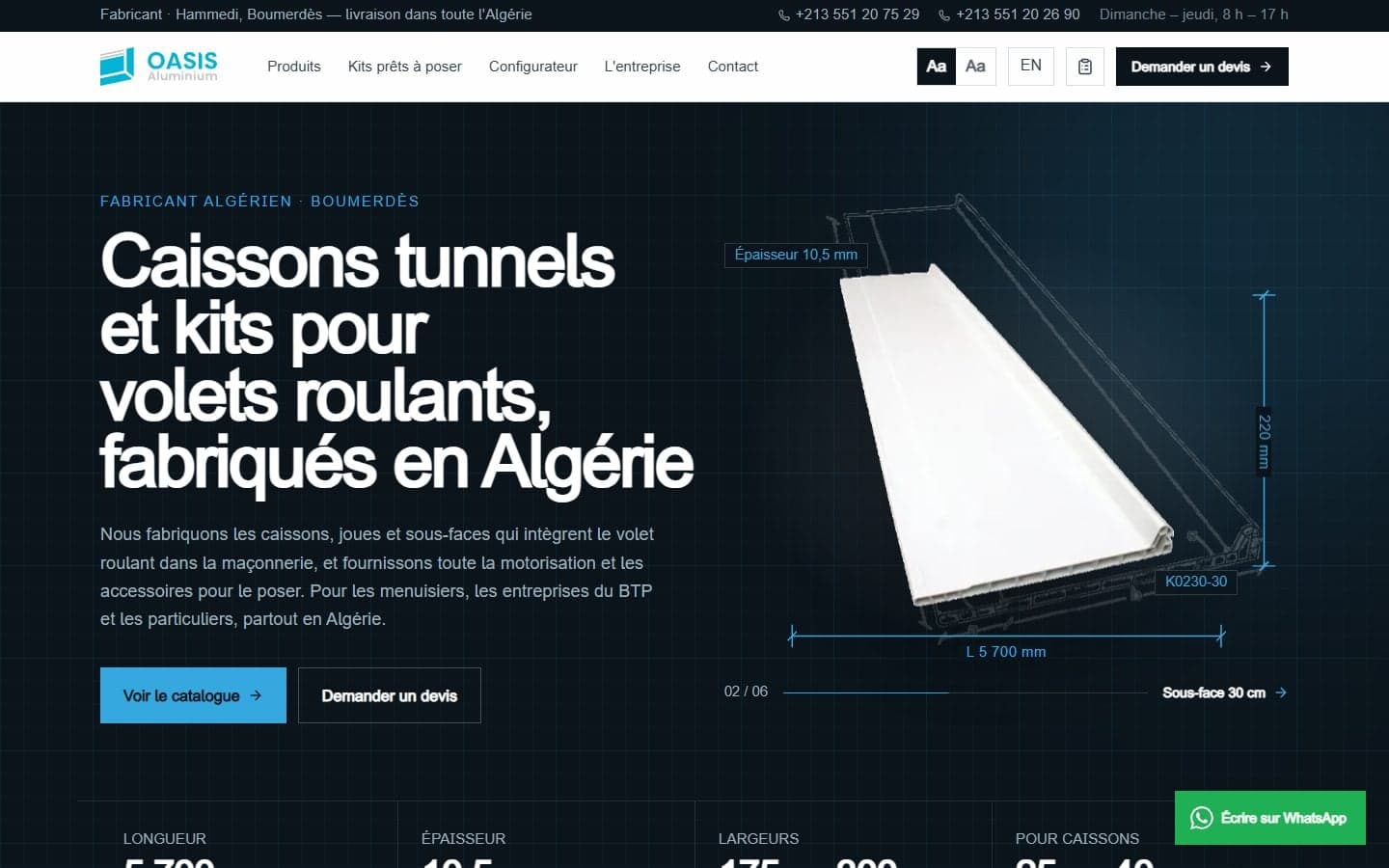
The manufacturer first
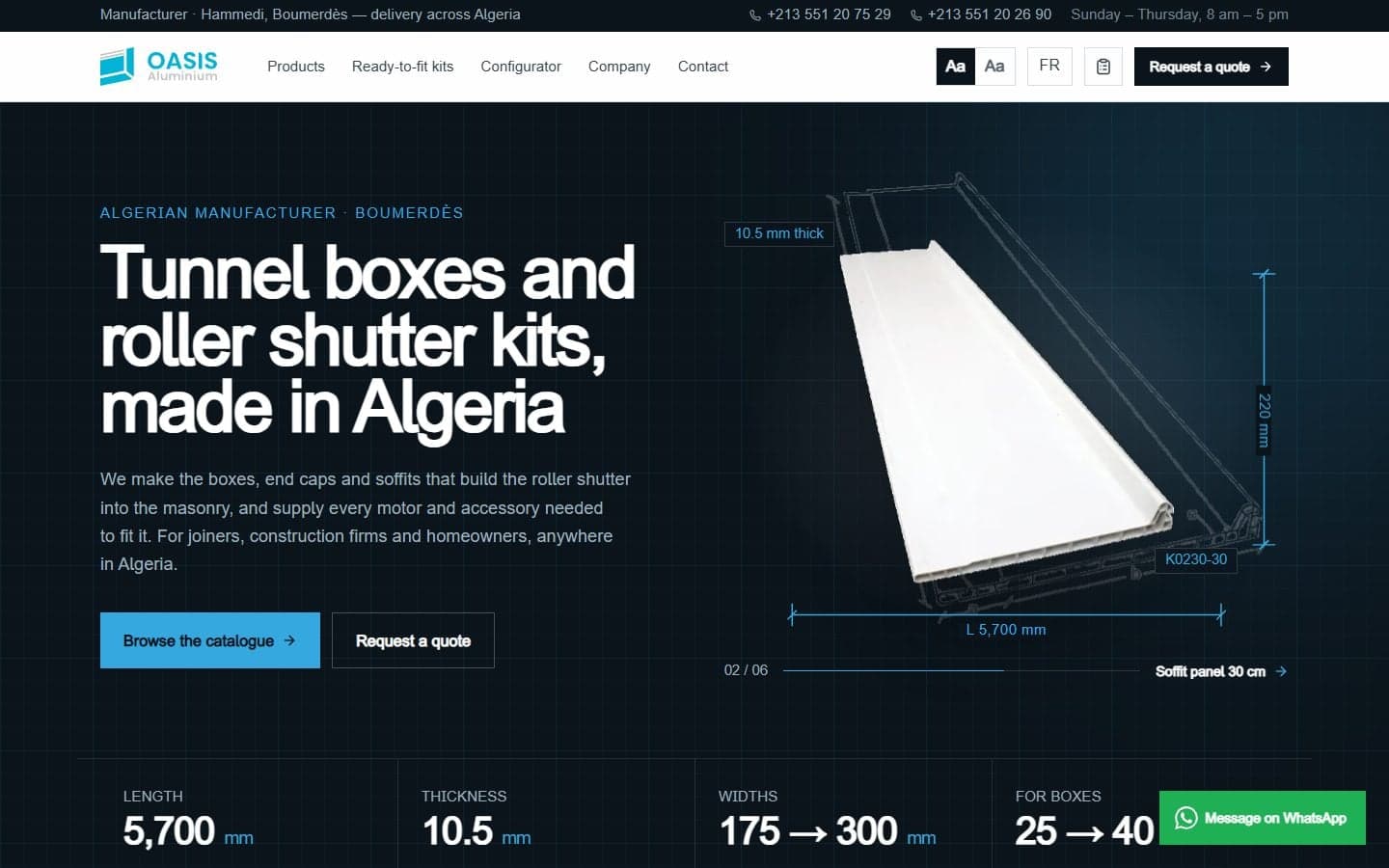
The old site spoke like a shop. The new one opens with what Oasis makes: a carousel of products sketched in pencil then revealed as photos, with their dimensions, then the eight ranges, a cross-section of a tunnel box and the six kits ranked by load.
- An animated intro: the logo assembles itself, then the screen rolls up like a shutter.
- A drawing-board background and blue dimension lines borrow from technical drawings.
- Photo and video slots still empty show the expected framing for the photographer.
Interactive demo · scroll
The 70 mm heavy kit, taken apart as you scroll
The home page's centrepiece, replayed here as it runs live: a white drawing on a blueprint sheet. The box lifts off then turns to show its section, the motor slides out of the tube, the plates turn to face you, and every part gets its balloon, its line in the parts list and its dimensions. Hover a number to identify it. Entirely drawn in SVG from the kit's composition: no images.
Assembled view
Scroll to take the kit apart ↓
Parts list
Catalogue
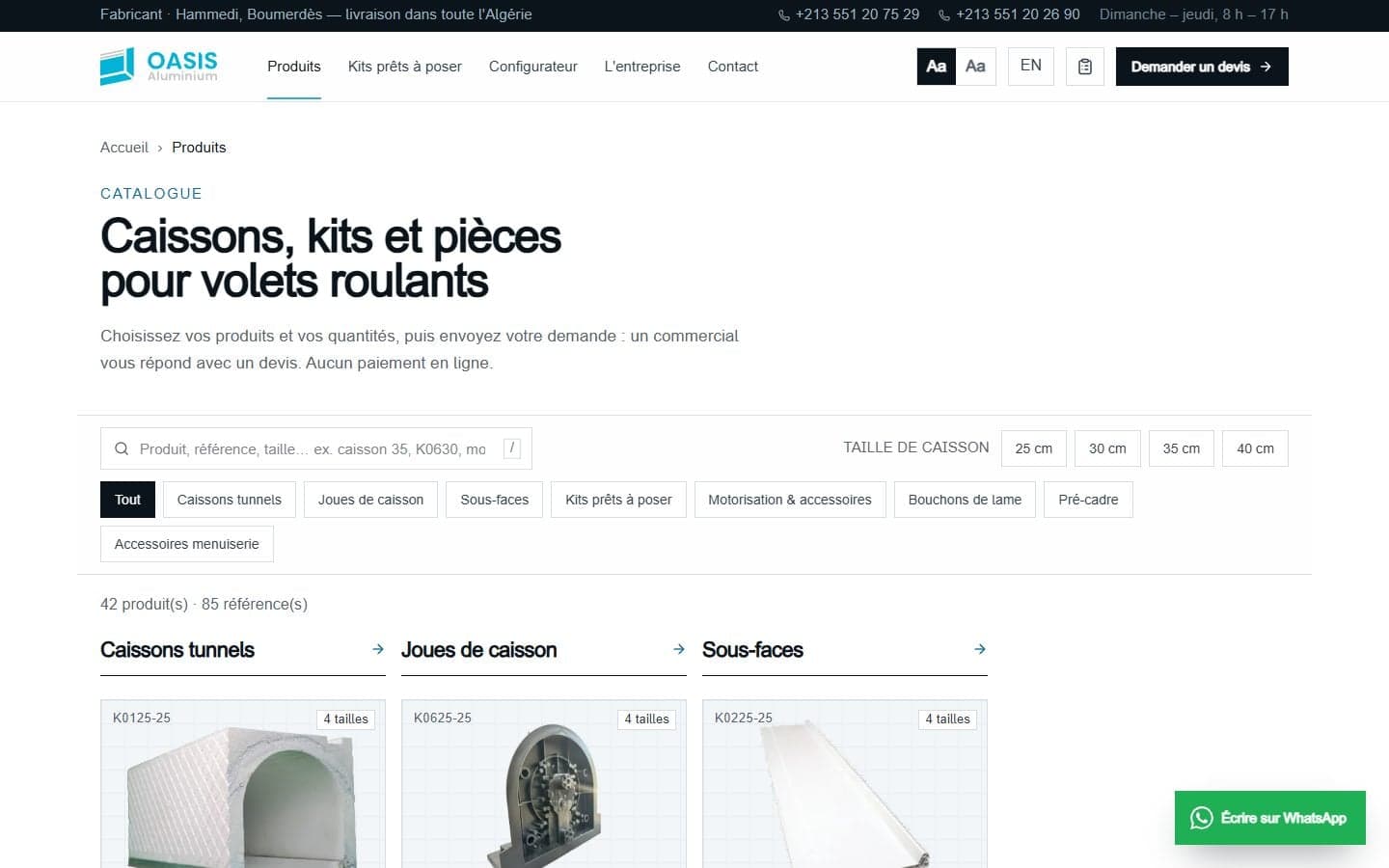
85 references, findable the way the trade looks for them
The catalogue was rebuilt from the client's PDF: one page per product, its variants (sizes, diameters, torques) grouped, its specs and reference. Search takes a name, a size or a reference, and filters stay in the URL so they can be shared.
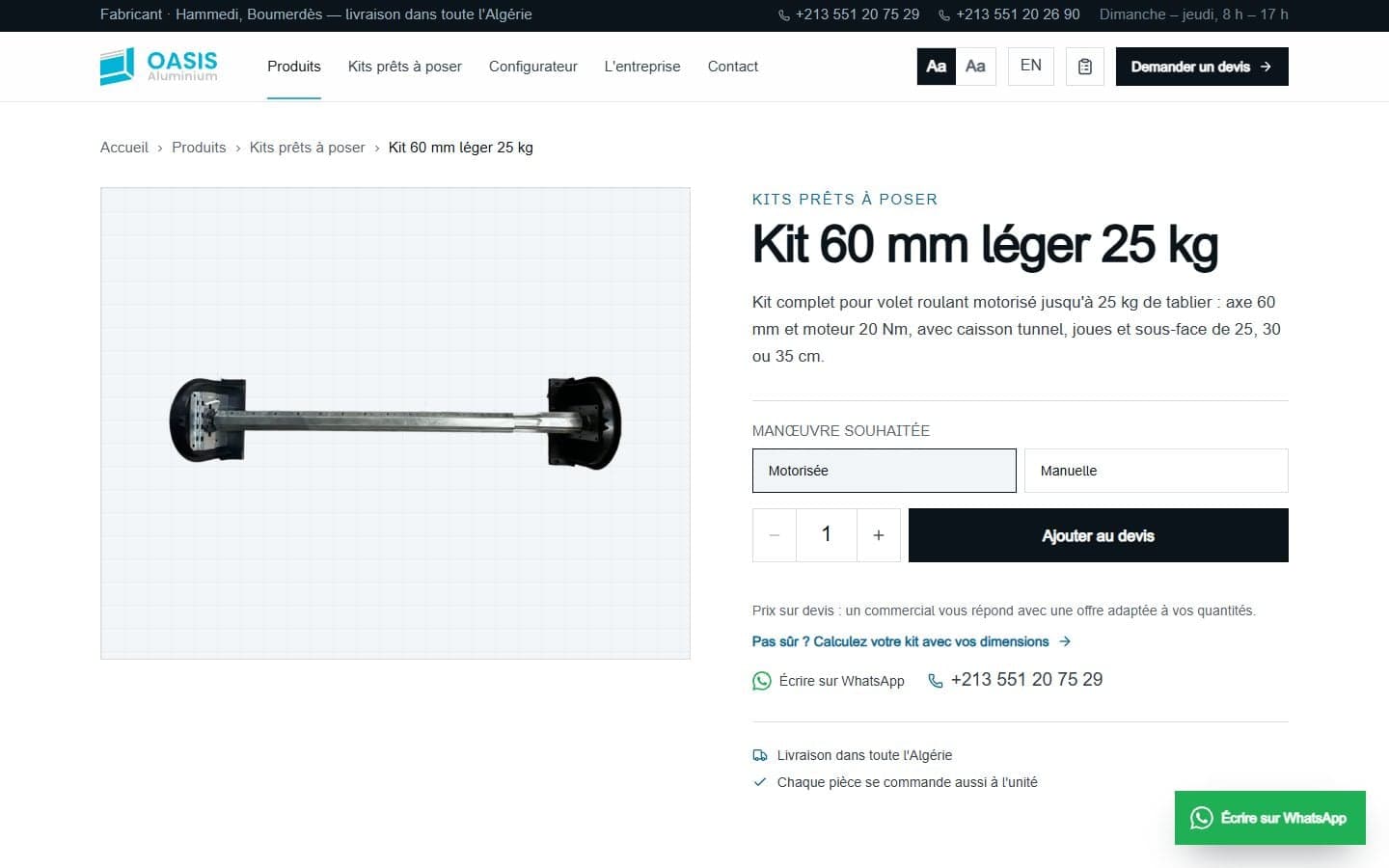
- On every kit, a simplified 3D exploded view comes apart as you scroll.
- On the kit's real photo, numbered pins open each part's page.
Choosing guide
Making the manufacturer's tables readable
The paper catalogue's charts and tables were redrawn as web components from their values — never pasted as images: they're accessible, translated and interactive.
- The tube chart: enter width and weight, and the recommended octagonal tube shows up.
- The six kits compared part by part, and a dimensioned drawing that scales itself.
Interactive demo · 3D measuring
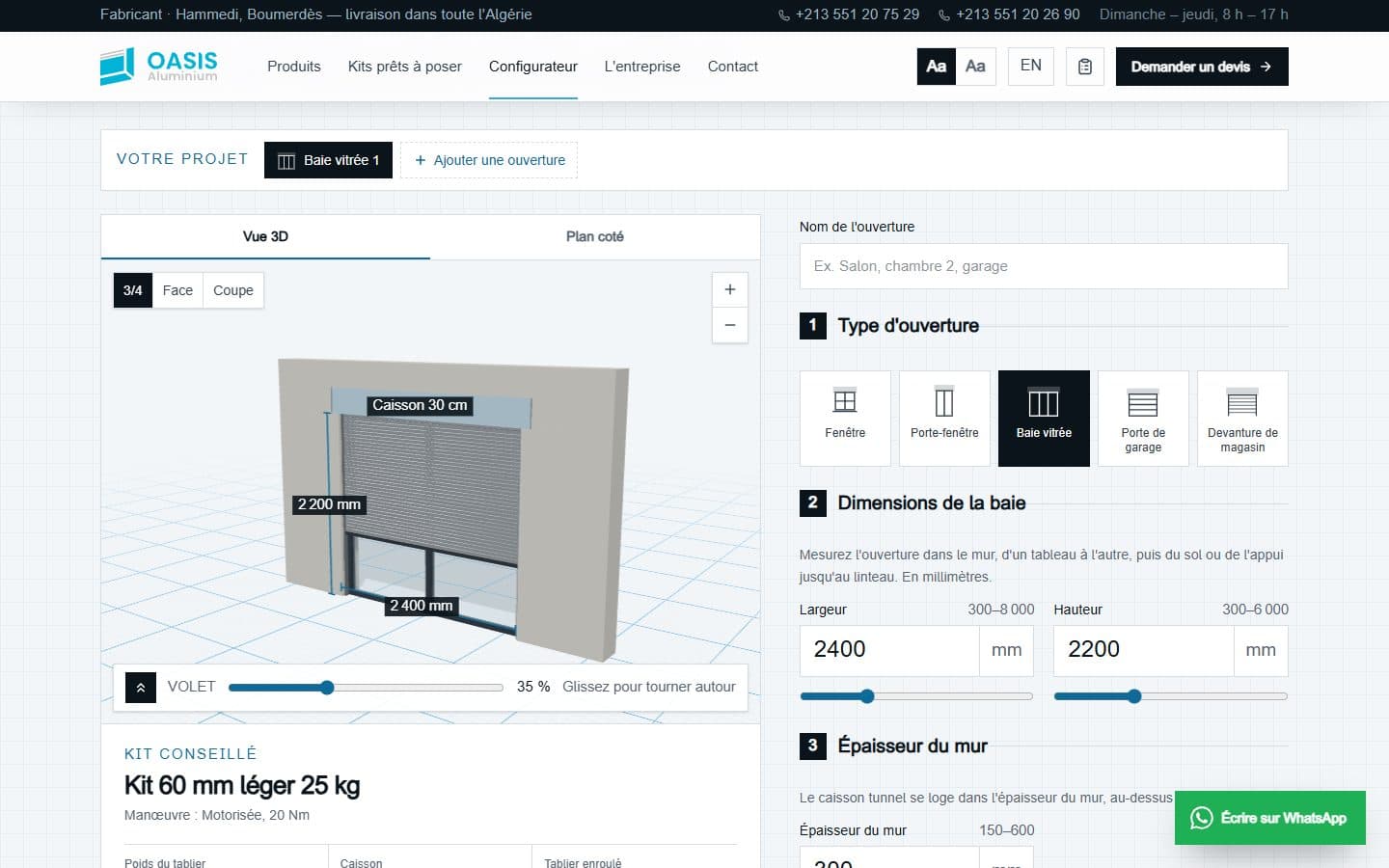
Measure an opening, the site picks the kit
The configurator's 3D view, here with a simplified measuring panel. Change the opening type, width, height or slats: the wall, the box and the dimension lines rescale, and the curtain weight, wound diameter, box and motorised kit are recalculated. Rotate the view, switch to section to see the curtain wound inside the box, open or close the shutter. Built with three.js, with no 3D model: only computed volumes.
What the site suggests
- Curtain weight
- ≈ 20 kg
- Wound curtain
- Ø 185 mm
- Box
- 30 cm
- Motorised kit
- 60 mm light kit 25 kg
Indicative sizing rules (common trade values), pending Oasis's own rules.
Configurator & quote
From measuring to a quote request ready to price
Customers add as many openings as they need (“Living room”, “Bedroom 2”…), each with its 3D view, dimensioned drawing and suggested kit. They join the products in the quote cart, then go out in two steps: summary, then contact details and attachments.
- Sales receive a summary PDF and an Excel file to price; the customer gets a copy.
- The server recalculates every suggestion instead of trusting the browser.
- 15 points of sale on a schematic map of Algeria, filterable by province.
Mobile
Built for the job site
Most professionals browse from their phone. On a portrait screen the exploded sheet turns a quarter turn to fill it, and the WhatsApp button stays within thumb's reach.
Beyond development
What the project took before the first line of code
The site is the visible part. Before it, a dedicated project page served as proposal, questionnaire and then progress tracker, and three strategy documents prepared the launch.
Audit of the existing site
Strengths to keep and ten issues to fix, measured and sourced: missing H1s, 287 images without alt text, indexed test products, 225 to 424 KB pages.
Repositioning & audiences
Six target audiences split into two journeys — products for joiners, dealers and builders, engineering for manufacturers and inventors — and user scenarios approved by the client.
Visual identity
A palette drawn from the brand guide with WCAG contrast checks, six font pairings to compare, vector logos extracted from the guide's PDF, and two typefaces switchable live on the site.
Strategy dossier
Site map and content map (ready or expected), a customer experience strategy from first contact to quote, and items awaiting the client's approval flagged.
SEO & lossless migration
Every indexed WordPress URL redirected, unique titles and descriptions, FR/EN hreflang, JSON-LD (business, products, breadcrumbs, FAQ), and a plan to keep the domain's mailboxes through the hosting switch.
GEO — visibility in AI tools
Verifiable facts written to be quoted by ChatGPT, Gemini or Perplexity, an llms.txt file, and a list of questions to ask AI assistants every month to track Oasis's presence.
Product data
The catalogue rebuilt from the client's PDF: references, kit contents read from the annotated photos, cut-out photos, and questions to the client wherever sources disagreed.
Photo & video brief
Every expected photo or video (workshop film, manufacturing steps, sites, installation video) is a slot that tells the photographer the format and what to shoot.
Proposal & phasing
Two offers and options to tick, a payment schedule and a phased plan — the configurator comes after the full catalogue, once the client's sizing rules are ready.
Site industriel B2B | Catalogue technique | Configurateur 3D | FR / EN | SEO & GEO